Ever since his election last year, Pope Francis has caught the popular imagination with his message of inclusion, mercy and hope. This has been particularly notable, for LBGT Catholics, beginning with the celebrated simple line, “Who am I to judge?” on the flight back from Brazil, and continuing (amongst other memorable quotes) that the Church should be a “field hospital for the wounded”. This week, there was more of the same kind, without the rhetorical flourish. To resolve problems of division and disagreement within the Church, he says, we need discussion.
In the church, as in any other situation, “problems cannot be resolved by pretending they don’t exist,” Pope Francis said.
“Confronting one another, discussing and praying — that is how conflicts in the church are resolved,” the pope said Sunday before praying the “Regina Coeli” with visitors gathered in St. Peter’s Square.
The pope focused his remarks on the day’s first reading, Acts 6:1-7, which describes how the early Christian community, as it grew to include people from different groups, began to experience internal tensions, and how those tensions were resolved at a meeting of the disciples.
-
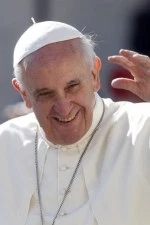
- Pope Francis
-
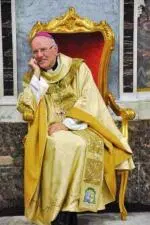
- Bishop Galantino
Last week, Francis’ point man in the Italian Bishops’ Conference, whom he had personally handpicked as its secretary general, said much the same thing. Bishop Nunzio Galantino told an Italian newspaper that the Church needs to listen, “without taboos”, to all the arguments in favour of gay relationships, married priests, and communion for the divorced.
Welcome words? Well yes, of course - but for queer Catholics, they remain just words, sizzle without the steak. We cannot have the proposed frank discussion to resolve conflicts, in a climate of fear. The Church cannot be a field hospital for the wounded - while continuing to inflict the wounds.
For far too many, this fear is all too real, and well founded. I’ve seen it in a small way myself, when I was told by Cafod that I was not acceptable as a school volunteer, because I publicly criticize some aspects of Church teaching: some aspects, evaluated against other aspects, and in the light of the Gospels. In other words, I attempt to stimulate precisely the discussion suggested by Pope Francis, to which Bishop Galantino says the Church should listen. In my case, this exclusion was not of any material consequence, but it was nevertheless emotionally deeply hurtful: a wound inflicted by the Church, not healed by it. ( See”“Despised and Rejected - but also “Phall if you but will, rise you must”)
For others, the consequences, and reason for fear, are much greater: loss of employment and livelihood. Pope Francis may ask, “Who am I to judge?”, but that has not stopped a series of bishops taking it on themselves to judge, and if those employed in parishes or church schools are found to be gay and honest in their relationships, forcing them out of their posts.

For still more, the issues are not about employment, but deeply spiritual matters. I was moved by a reader’s response to the Bondings 2.0 report on Bishop Galliano. After recounting some local church history, and an active witch hunt against gay men and lesbians in that diocese, she continues:
In truth, now I won’t admit to any priest I’m lesbian. I’m too worried that if something happens to me and I need last rites, the very priest to whom I admitted I was gay will be the same one walking in the hospital and denying me last rites (and possibly attempting to excommunicate too boot ). Call me paranoid or chicken or both but I just don’t want that to happen. I’m more than happy to stand up for other people but .. not so much for myself. Seems pointless to do so much of the time.
Even for those with nothing much to lose, who are able to set aside this fear, and come out openly as both gay and Catholic, there remains another problem. Frequently, they may find full acceptance, inclusion and welcome in a local congregation - as I do myself. Such local congregations may indeed be those field hospitals for the wounded that Pope Francis extols. From the institutional Church, and from some sections of the church - not so much. Fr James Martin SJ wrote about this last week at America, in a piece called Simply Loving. At Bondings 2.0, Frand DeBenardo headlined his report on Martin’s post with a pertinent question, “Why Do LGBT People Feel the Catholic Church Hates Them?” One reason suggested by Fr Martin, was that when LGBT people hear the Church, or people speaking on behalf of the Church, about “homosexuals”, it’s almost always accompanied by words about sin - even when the words are intended to be welcoming and helpful.
As always with Martin,his piece is thoughtful, compassionate and sensitive. However, when read together with the reader responses, it simply highlights the extent of the problem. When I read it a few days ago, the first comments I came across seemed to be saying,
“Excellent piece, well done - but after all, we really must remember that homosexual acts are indeed sinful”.
Plus ça change, plus c’est la même chose!
Related articles
- Senior Bishop: We Need Frank Discussion - Without Taboos
- Pope says church tensions must be resolved with discussion, prayer
- “Despised and Rejected”: A Personal Anecdote
- “Phall if you but will, rise you must”
- “Campaigning”: That Word, Again.
- Why Do LGBT People Feel the Catholic Church Hates Them? (Bondings 2.0)
- Simply Loving (James Martin SJ, at Americablog)
- Why Are African Bishops Flagrantly Flouting Church Teaching? (queeringthechurch.com)
- Pope Francis, on Why and How the Church Must Change (queeringthechurch.com)
- Pope Francis On The Possibility of Married Priests (enlightenedcatholicism-colkoch.blogspot.com)
- Pope’s man in Italy on abortion, homosexuality & Communion for the divorced & remarried. (commonwealmagazine.org)
- Catholic Bishop of Arkansas Attacks “Same-Sex Marriage,” Calls on State Supreme Court to Close Door Opened to Gay Couples to Marry (bilgrimage.blogspot.com)
- Top Catholic Bishop Says Church Should Consider Accepting Gays (thinkprogress.org)


Well said Terence, thank you for so cogently expressing the core of the matter, as usual! We seriously need to get away from all notion of homosexuality being ‘sinful.’ Even kind, humane, ‘liberal’ people within the Church structure seem beset with this. A male Religious I confessed to treated the matter as an inconvenient nuisance that I should just stop being involved in or speaking about, and a female Religious told me in no uncertain terms that it was a sin, dirty, disrespectful, and she is now trying to ‘pray away my gay.’ No chance! I look forward to one day coming out of the closet and getting fully involved with my God-given homosexuality!
Thanks. In similar vein, I’m thinking about a follow up, about “the sin of heterosexuality”. If “homosexuality” is invariable coupled with “sin” - why not the sin of heterosexuality: rape, prostitution, child abuse and the like? Straight sex is not always in the context of loving, committed, mutually respectful marriage, and open to procreation. Some gay sex is sinful, so is some straight sex. Some straight sex is not - some gay sex is not.
And I look forward to the day too, Paul, when you can: but only when you are ready.
Thank you so much! I am nearly ready: the Church and society are not! I agree totally about heterosexual sin, we are all sick of homosexuality and child abuse being equated together. I enjoy homosexual relations with all ages, but always over 20.
Some thoughts that occur to me - much later than to some, no doubt:
If the Church can tolerate people with non-Catholic morals, such as Protestants, and non-Christian morals, such as Jews, Sikhs, Muslims, atheists & others - why is it so difficult for the Church to tolerate people who are gay ? A lot of gay people differ from Catholic orthodoxy on nothing but this one issue; yet the Church gets on perfectly well with people who regard her Founder as inferior to Mohammed, or as a rather doubtful Jew.
It’s not even as though all gays are Catholic - the Church can & should provide for them, but has either indirect or no jurisdiction over any others, many of whom are not even baptised or Christian. And the Church does not claim, or not now, that leaving in a plural society is a limitation of or an assault on her - according to Dignitatis Humanae, she “asks nothing but freedom” - by that apparently meaning civil freedom. She has freedom in UK society - so why is it so difficult for the CC to treat gay people with the same respect as it treats so many other groups with which it disagrees, often on even more important matters ? Or is adhering to a non-Christian religion that allows polygamy a lesser failing than having a lover of the same sex ? The Church’s position really does not seem to make a lot of sense. A Church whose Popes & cardinals have no qualms about praying with Muslims and Sikhs, can hardly frown on gay people & what they do, in the way the CC does.
No matter how I try to look at this, I can’t see how the Church’s position makes sense. I’m trying to see the Church’s position as coherent - and I can’t. Maybe there is something I’ve overlooked. If so - what ? Its position may have made very good sense, before the Church went ecumenical after V2 - but now ? I don’t think so. By the force of the logic of the theological decisions it has made in other matters, the Church is - AFAIK - acting very illogically if it does not become, well, “gay-friendly”, and accept gay people as fully as it does “straight” people.
I don’t perceive my being gay as something to struggle with, or as anything dirty. I’m grateful for it. I have plenty of faults I struggle with - why does being gay not bother me in that way, if it so serious and so wrong ? I think I have a functioning conscience; I hope so. It *seems* to be assumed that gay Catholics have inactive consciences, that we can’t love God, can’t pray, can’t confess our sins. That may be true of some - but why must it be *assumed* to be true of gay Catholics ?
A frank discussion, without fear or awkwardness, is surely needed in the Church. I agree with all the earlier posts in the thread.
leaving in = living in
“I’m too worried that if something happens to me and I need last rites, the very priest to whom I admitted I was gay will be the same one walking in the hospital and denying me last rites (and possibly attempting to excommunicate too boot ).”
## I don’t think such a denial would be allowed, because of the principle that “the salvation of souls is the supreme law”. There are precedents in the history of the post-Apostolic Church for the giving of the sacraments to those on their deathbeds, even although those dying were ordinarily denied the sacraments, when not in danger of death. Practice varied a great deal; some churches were much stricter than others - but as a rule of thumb, one can say that the sacraments even to the dying only in some periods, by some Churches, and only for extremely serious sins. But modern pastoral practice, in the Catholic Church even more than in the “Orthodox”, has for some centuries become ever milder. So it seems most improbable, for those reasons as well as for others, that the authoress of that quotation would be denied the last rites.
Quite apart from anything else, it is an extremely serious matter to deny the last rites to those in need of them - reverence for the sacrament has to balanced against the well-being & need of the would-be recipient. Since a would-be recipient of the laast rites is - ex hypothesi - in danger of death, the need of such person for the last rites could hardly be greater. The LR, are, after all, intended for precisely such people in such circumstances - so there would have to be exceptionally weighty reasons to deny them to a Catholic who in good faith asked for them when in danger of death.
The Sacraments, after all, are not the property of the Church; it does not own them - they are not objects, but actions, of Christ the Saviour, carried out in His Church (never “ours” or “mine” !) for the salvation of those whom He has chosen to be His own. They are not rewards for good behaviour, not in the slightest, but gifts of God’s free and underservable grace, that come to us, not because we are good, but to make us good. ISTM that gay people are - by the Church’s own reasoning - the very people who should be admitted to the sacraments.
AFAICS, if gay Catholics are no more - and no less - sinful than any other Catholics, there is no less - and no more - reason to deny the sacraments to other, “well-behaved”, Catholics, than to gay Catholics. One is presupposing as valid the assumptions - granted only for the sake of argument - that “gay acts” are (a) sinful; & (b) that they are more sinful than the sins of Catholics who sin in other ways but are allowed the sacraments. There are theological difficulties, from within traditional Catholic moral theology, w/ both propositions.