A frequent theme in the assessments of John Paull II runs along these lines, written in this case by E. J. Dionne at Commonweal:
When historians look back, John Paul’s greatest achievements will inevitably be seen as liberal, in the broadest sense: his commitment to human rights and religious liberty, his calls for greater social justice, his embrace of workers’ rights (“the priority of labor over capital”), and his strenuous opposition to religious prejudice. Recall that John Paul was the first pope—not counting St. Peter—to visit a synagogue, where he issued a ringing condemnation of anti-Semitism.
What I find astonishing in this, is its myopia. While I welcomed JPII’s obvious and strong commitment to all these good things in the secular world, I cannot share in the adulation for a leader who urges on others, what he steadfastly refused to do himself. His commitment to worker rights was contradicted by his disregard for those principles in dealing with the bishops and theologians with whom he disagreed. His calls for social justice did not extend to the victims of clerical sexual abuse.
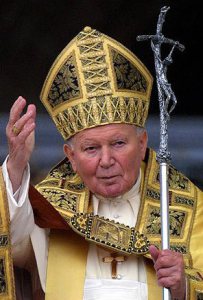
John Paul of course did not create the Vatican dictatorship, but he did go a long way to derailing the promising reforms of Pope John XXIII (Dionne’s remarks on JPII quoted above were made in the context of a proposal to detoxify the imminent beatification by moving ahead with the cause for John XXIII). The problem is that there is a deep-seated autocratic, monarchical culture in the Vatican, which has nothing to do with either Scripture, or the earliest traditions of the Church. A useful article by at National Catholic Reporter traces the historical background. Here are some extracts:
John Paul beatification highlights dysfunctional monarchy
Within a two-day period this week, contrasting monarchical spectacles will compete for billions of TV viewers. The first will involve a likely future king’s wedding; the second, the beatification of a supreme pontiff.
Many will enjoy the glamour of Kate and Will’s English royal wedding as a revolution that long ago replaced a once unaccountable British monarchy with a more benign parliamentary monarchy. By contrast, many have expressed deep reservations and concern about the second ceremony, a pageant aimed at brightening a dead pope’s memory by adding spiritual acclaim.
The protesters draw their energy and angst from the well-documented failings of Pope John Paul II, soon to be Blessed John Paul II, in his handling of our church’s child abuse debacle.
Survivors of clergy sex abuse see the hurried beatification as nothing less than more church salt in deep personal wounds.
At the core of the sex abuse issue and the beatification as well is a festering sense of a system totally lacking in accountability to its ordinary people, to the laity of the church.
Traditionalists defend the monarchical structure, saying take it or leave it, that the absolute monarchy of our church structure has somehow been willed by God. But that surely is incorrect.
Incontrovertible historical evidence indicates the early church operated successfully with a structure that was consensual, not fundamentally monarchical in nature — for at least three centuries, until Roman emperors intervened. Through the centuries, our church’s governing structure has been patterned more on European courts and kings than the scriptures or creed of our faith.
Pope John XXIII had significant diplomatic experience abroad and a broad and different vision. On unexpectedly succeeding Pius XII, he unilaterally decided the time was ripe to update the papacy and to adopt a more positive and collegial pastoral style. He shocked his curia by calling a church council, the Second Vatican Council, which began in 1962 and ran through 1965.
The Roman court, or curia, was further shocked when the 2,500-plus council bishops early on rejected overwhelmingly its draft proposals, aimed at preserving curial power. Pope John XXIII backed the bishops, but died before the second council session began.
Pope John’s successor, Pope Paul VI had earlier served for many years in the curia. He evidently was elected with significant curia support and proceeded to confirm traditional monarchial ways, removing celibacy, contraception and curial reform from the council’s consideration. In the process he thwarted the council’s emphatic attempt to confirm the college of bishops as co-equal with the pope. The council’s bishops may have initially ambushed the curia, but it soon had recovered its elevated status
Pope Paul VI’s eventual successor, Cardinal Karol Wojtyla, was elected in 1978. For decades he had been a leader of the tightly controlled church in Poland. As supreme pontiff, he brought his governing habits to the larger church. The result would be the restoration of unbridled monarchical authority after he stripped Vatican II-inspired national conferences of bishops of all practical and possible countervailing authority.
This structure of absolute papal authority, vested in the monarch, has sought and received, through the process of papal appointments, the total control of clerics, doctrine and liturgy, as well as an unremitting suppression of alternative views.
And it has done this in the name of preserving “orthodoxy,” when, in fact, it has been much more about power and structure. A more authentic Catholic view would hold to unity in creed and charitable pluralism in theologies and ecclesiology.
Gerald Slevin, NCR
It is this insistence on unresponsive, total control from the centre that has been a major contributor to the sexual abuse crisis in the modern church,which has been widely noted. But there is much more here, a deep irony which has been less widely noted.
When South African President FW de Klerk in 1990 announced the unbanning of the previously proscribed ANC and other liberation movements, and the imminent release from prison of Nelson Mandela and other political prisoners, it abruptly signalled the end of apartheid, in a move that caught the world by surprise. In fact though, this was not the beginning of the end of apartheid, but a dramatic acknowledgement that in practice, apartheid had already ended. Over the previous decade, had become accustomed to simply ignoring the elaborate apartheid structure, and even the military and police might that tried to enforce it.
Much the same thing has been happening in the Catholic Church.
In addition to the sexual abuse crisis, the failure to respond as a listening church to the experience of ordinary Catholics has led directly to the ease with which so many Catholics simply disregard the orthodox teaching on sexual ethics of all kinds. Catholics Attempts to silence theologians and priests by removing them from teaching in Catholic institutions, or to prohibit them from publishing, has simply led them to teach elsewhere, or to continue publication by leaving the priesthood. Ignoring the obvious need to relax the absolute insistence on clerical celibacy has resulted in a substantial proportion of priests conducting sexual lives outside of marriage, often with the knowledge and tacit acceptance by parishioners and even some bishops. The complete failure to provide properly for women in ministry has given rise to the growth of the womenpriests movement, which ordains women and married men without Vatican approval. In some local instances, bishops’ unilateral attempts to close parishes or to remove popular parish priests without consultation and consent of the parishioners, has resulted in the people simply relocating to new premises, outside of episcopal control. At its simplest manifestation, this turning away from orthodox Catholicism is shown by the numbers who are simply moving away from the Church, either completely, or by disengagement from its sacramental parish life.
In the South African example, people learned to ignore unjust laws, even in the face of formidable military might. In the Catholic Church, the only power held by the bishops over lay Catholics is the control of our minds. The sexual abuse problems gone a long way to undermine what was once the profound awe of the laity for those who held the power in the church, mixing it with a substantial measure of suspicion and distrust.
So here’s the great irony behind the papacy of John Paul II: in his efforts to reassert total control within the church by resisting the move to internal change, he has in fact ushered in an era in which the Vatican has steadily been losing control: over the consciences of the laity, over its theologians, and even over clerical discipline. We are moving towards a position where we will no longer need “change” in the Catholic Church. Instead, as FW de Klerk did in South Africa, we will be waiting for acknowledgement of the profound changes that have already taken place.

