We are all familiar with the kind of argument against marriage equality, or against relaxing Vatican proscriptions against assorted forms of sexual behaviour, that complain of a “slippery slope” in sexual morality, alleging that it all started to go wrong with the discovery of the pill, since when there’s (been allegedly) a steady decline in standards of sexual morality. In the first post that comprises his discussion of Chapter Two of “On the Meaning of Sex”, Frank describes how Budziszewski lists several examples of the sad, distressed lives of modern young people who have embraced sexual hedonism. The trouble with this, says Frank, is that it is simply not true that modern young people are any less responsible sexually, than their forebears:
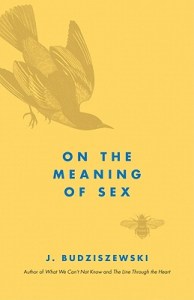
I could write 8000 words about the ways Budziszewski misrepresents his students, but I’ll try to keep it brief so we can move on to the meat of his argument. Here’s reality:
-Young people are waiting longer to have sex today than they have in years, and they don’t have more sex or more sexual partners.
-The teen pregnancy rate is at an all-time low. Yes, all-time, as in going as far back as statistics have been collected.
-In case you’re wondering, that’s not because teens are having more abortions. The abortion rate has dropped like a rock over the past three decades.
-Young people are using fewer drugs and committing fewer crimes than their parents did in the 1970s and 1980s.
—But marriage is on the rocks, right? Aren’t divorce rates skyrocketing? No, they peaked around 1980 and have dropped moderately ever since.
This fiction that young people are having more sex, or more daring sex, than their elders, is not new. Way back in 1967, Philip Larkin, wrote much the same thing (with regret, not complaint) in “Annus Mirabilis”, which begins
Sexual intercourse began
In nineteen sixty-three
(which was rather late for me) -
Between the end of the “Chatterley” ban
And the Beatles’ first LP.
This is not to say that nothing has changed - of course it has. Frank acknowledges for instance, that “more and more people are having kids out of wedlock”, but this is not attributable to teenage unplanned pregnancies. (Many of these are older people who are delaying or rejecting marriage, but taking deliberate decisions to have children).
More importantly, this reflects a common weakness in so much of conventional platitudes about sexual morality, from the Vatican and armchair theologians alike: a complete absence of any awareness of reality. A core component of “natural law” theory on which he and other conservatives attempt to build their structures of sexual ethics, is that we can judge the badness or goodness of an action by its effects in the world. But instead of working from the evidence to the conclusions, as Aquinas would have done, there is a tendency to begin with Aquinas’ conclusions, and assuming them to be sound, to reimagine the evidence so as to support him. What is needed now, is not greater respect for the lessons that Aquinas drew from natural law based on the scientific knowledge of the day, but a more complete understanding of the principles and methods that produced them.
In his second post on this chapter, notes another of Budziszewski’s weaknesses that has much in common with so many defenders of orthodox Catholic theology:
Okay, on to the next step. In Chapter 2, Budziszewski is focused on showing us the “meaning and purpose” of the human sexual powers. And, through the course of the following pages, he is going to show us how two can become one.
What’s that? You’ve heard this before?
No, no, no. I’m not talking about Mark 10:8 or Genesis 2:24, two becoming one flesh and all that mushy stuff. I just mean that Budziszewski starts out by claiming sex has two purposes, but ends by building an argument that it only has one.
Vatican teaching on sex is absolutely clear that there are two purposes to sexual intercourse, the procreative, and the unitive. What’s more, the documents spell out there is not a hierarchy to these: procreation is not more important than the unitive value. Both are equally important. In practice however, it is usually the procreative value that is insisted on - because any serious consideration of the unitive value leaves a way open to respect all manner of forms of sexual behaviour that are rejected a posteriori as unacceptable.
(In “Catholic Teaching and Homosexuality”, Louis Cameli provides a particularly extreme example of this phenomenon. Having noted the teaching gives equal importance to both procreative and unitive functions, he simply states that he sees “no need” to discuss the unitive value. Instead, he continues by repeatedly insisting that sound use of human sexuality requires that it be “life giving”. In a bizarre attempt to give comfort to gay and lesbian Catholics, he then observes that “life giving” need not necessarily imply biological procreation. Celibate priests, for instance, can “give life” to others, in their service and ministry. So, he argues, Catholics deprived by Catholic teaching of legitimate sexual expression in marriage, by finding “life - giving” expression of themselves in other forms of service - but ignores the obvious conclusion from his own argument: that by the unitive function of sex, loving, faithful and committed same - sex relationships can be “life - giving” in the same non - biological sense, of “giving life” to each of the partners).
And both Budziszewski and Cameli, along with the Catholic apologists, simply ignore what is well known to many secular theologians, to the professionals who study human sexuality seriously, the psychologists, sociologists, sex therapists and even scholars of animal behaviour: there are other purposes for sex beyond just the procreative and unitive - including the recreational. For many people, and much of the time, the main reason for seeking or engaging in sexual intercourse is that it’s fun.
Frank’s Series, to date:
Series Introduction
1. Your Students Are Smarter Than You Think
2. Don’t Believe in Modern Love
2(b). And Two Will Become One
4(a) On the Perfect Marriage Between Dante and Beatrice (Hey, Wait a Second)
4 (b) More on Dante and Beatrice (And What About Gemma?)
Recommended Books on Sexual Ethics:
Beattie Jung, Patricia (ed): Sexual Diversity and Catholicism: Toward the Development of Moral Theology (The Liturgical Press, 2002)
Clark, J. Michael. A defiant celebration: theological ethics & gay sexuality
Cornwall, Susannah: Theology and Sexuality
Farley, Margaret: Just Love: A Framework for Christian Sexual Ethics
Hanigan, James: Homosexuality: The Test Case for Christian Sexual Ethics
Heyward, Carter: Touching Our Strength: The Erotic As Power and the Love of God
Kamitsuka, Margaret D: The Embrace of Eros: Bodies, Desires, and Sexuality in Christianity
McNeill, John: Sex as God Intended
Rogers, Eugene F. Sexuality and the Christian Body: Their Way into the Triune God
Salzmann, Todd A., and Michael G Lawler, The Sexual Person: Toward a Renewed Catholic Anthropology
Stuart, Elisabeth and Adrian Thatcher: People of Passion: What the Churches Teach About Sex
Related articles
- “The Meaning of Sex” (Letters to the Catholic Right)
- “The Meaning of Sex” Ch 1 (LTCR): The Value of Experience
- John Corvino Responds to “New Natural Law” (Book, and Video)
- Aquinas, In SUPPORT of Same - Sex Relationships.
- “What British Catholics Believe About Sex” (It’s Not the Catechism!)
- And So It Begins … ? (dish.andrewsullivan.com)
- More on Linda Woodhead’s Survey of What British Catholics Actually Believe: The “Big Con” of Magisterial Teaching about Sexual Morality (bilgrimage.blogspot.com)
- Catholic Sexual Ethics and the Category of Justice: A Reminder about Margaret Farley’s Pioneering Work (bilgrimage.blogspot.com)
- Recent Surveys on British Catholic Beliefs: “Discrimination Is Always Unjust and Counts More Heavily Than the Preservation of Traditional Marriage Patterns” (bilgrimage.blogspot.com)
- The Benefits of SEX (rotciescorts.wordpress.com)
- Is it good or bad to sow your wild oats? (psychologytoday.com)

