It’s not often that LGBT media pay any attention to religious leaders, other than to complain about their perceived (and sometimes actual) homophobia. So when a major gay magazine not only writes about one, but follows the lead of Time magazine in naming him “person of the year”, it’s worth paying attention.
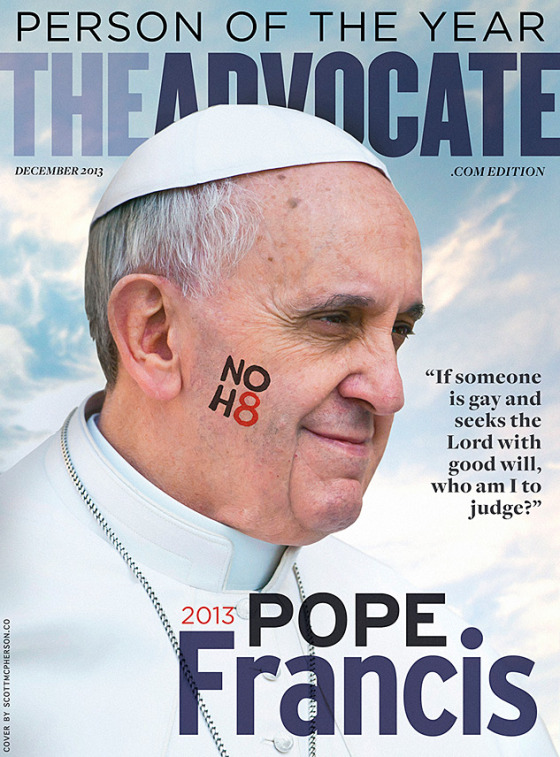
The most influential person of 2013 doesn’t come from our ongoing legal conflict but instead from our spiritual one — successes from which are harder to define. There has not been any vote cast or ruling issued, and still a significant and unprecedented shift took place this year in how LGBT people are considered by one of the world’s largest faith communities.
Pope Francis is leader of 1.2 billion Roman Catholics all over the world. There are three times as many Catholics in the world than there are citizens in the United States. Like it or not, what he says makes a difference. Sure, we all know Catholics who fudge on the religion’s rules about morality. There’s a lot of disagreement, about the role of women, about contraception, and more. But none of that should lead us to underestimate any pope’s capacity for persuading hearts and minds in opening to LGBT people, and not only in the U.S. but globally.
The remaining holdouts for LGBT acceptance in religion, the ones who block progress in the work left to do, will more likely be persuaded by a figure they know. In the same way that President Obama transformed politics with his evolution on LGBT civil rights, a change from the pope could have a lasting effect on religion.
- Advocate.com.
“Homophobia” is an emotive word, and an ugly one. There are times when it’s use is appropriate, but many others when it is not, especially when it is used to label anyone who is opposed to same - sex marriage. The medical definition of “phobia” specifies a fear that is “irrational”, but there are many people, including some LGBT activists, who have carefully thought out reasons for opposing gay marriage. That entirely rational opposition hardly qualifies for a label of “homophobia”. So, for now at least, let’s set aside that word, and use instead the less emotive, more precise term of “prejudice” - an attitude of prejudging a person or community, often based on misperceptions or stereotypes. Catholic leaders often insist that the Church is not anti-gay, but as Michael O’Loughlin notes at Relgion Dispatches, many of its bishops are clearly prejudiced against us. These negative perceptions in turn are frequently based on stereotypes (i,e. “prejudice”) as even Archbishop Cordileone of San Francisco has conceded in a recent interview with KQED News
In our discussion, Archbishop Cordileone said he’s been reaching out in hopes of “getting to know gay Catholics,” joining parishioners for meals at Most Holy Redeemer Church in the Castro.
“When we don’t interact with each other, we can make decisions or get images based on stereotypes – that happens on both sides,” the archbishop said.
When asked what he’s learned from those interactions, Cordileone said he’s come to understand how gay people have “suffered.”
These stereotypes and misperceptions are found not only among many Catholic bishops, but even embedded in many of the formal documents of the Church.
Conversely, many LGBT people are deeply suspicious of religion, particularly the Catholic Church, or even deeply hostile. Much of this certainly cannot be described as “phobia”, as the grounds for it are anything but irrational. The suffering that our community have endured under bigotry and discrimination masquerading as religious virtue, are very real indeed, in history and in the present. Cordileone concedes this, too:
When asked what he’s learned from those interactions, Cordileone said he’s come to understand how gay people have “suffered.”
“They’ve been disowned by their families,” he said. “They’ve been harmed and they want to come to a place that will accept them for who they are. And affirm them. So it tenderizes us.”
But here too, not all the opposition to religion is entirely free of prejudice. There is often insufficient distinction in press reports between the religion - inspired bigotry of some religious leaders, and the reality of acceptance and full inclusion in a growing number of religious denominations and local congregations (including many Catholic parishes). There is a similar lack of understanding of how the frequent textual abuse of the Bible, by misrepresentation of the infamous clobber texts at the expense of the authentic message of inclusion and justice for all found in the Christian gospels. Far too many queer activists are either unaware of the large number of LGBT supporters we have inside the churches, or if aware of LGBT people of faith, condemn us as traitors to the gay cause. Undeniably, prejudice against religion and religious people exists within the LGBT community, just as anti-gay prejudice exists among some church people.
Just as meeting with gay people has helped to soften Archbishop Cordileone’s harsh perceptions of gay people, so can meeting with religious people, or even just better and more complete reporting of the facts, can help to counter LGBT prejudice against religion. For that reason, the Advocate honour for Pope Francis is most welcome.
The article itself does not have anything in it that is particularly new or startling - but it may be new to some people, in both the LGBT and faith communities, who have been accustomed to ignoring the facts from the other side. However, one feature that becomes particularly interesting when read in conjunction with Cordileone’s observations on meeting with people as a way of breaking down prejudice.
The Advocate first asks as others have done, if the Pope’s markedly more sensitive and pastoral tone is simply that, or can it go beyond, to a change in doctrine.
One could imagine how acceptance of LGBT people might fit into the pope’s case for loving every human being and valuing the contribution made by each to society. With less than a year as pope, Francis still must show whether his aspiration ends at not being our enemy. Will he be an agent for fighting our discrimination worldwide?
In fact, we know that Francis has given no indication, anywhere, of any change in actual doctrine, but one of the ways in which his pastoral tone could later lead to the necessary change in teaching, is suggested by repeated references in the Advocate article to a practice of listening to the experience of gay people, which he has described in both his in - flight impromptu press conference, and in the extended interview with Jesuit magazines.Later he did something no previous pope had done - he replied directly to an Italian LGBT group that had written to him.
This commitment to listening and dialogue is further confirmed, for people of all sexual orientations and marriage situations, by his calling an Extraordinary Synod on marriage and family for 2014, and the unprecedented stress on widespread consultation of the whole church, explicitly including laity. That widespread listening and consultation has become an intrinsic part of his style, is further confirmed by numerous Vatican reports on his dealings with the Vatican officials, and with the bishops, and his emphasis on implementing the collegiality promised but not delivered by Vatican II.
It is also echoed by one of his most senior associates, a member of the advisory group of eight cardinals who now form the equivalent of an ecclesiastical cabinet, charged with overseeing the reform of the curia. Referring to Time magazine’s exposition of its nomination of Francis as person of the year, the Advocate notes:
Time magazine points out the unusual group of eight bishops that Pope Francis has convened to advise him regularly. Among them is Cardinal Oswald Gracias of India, who this month publicly condemned his country’s criminalization of homosexuality. India’s Supreme Court had just issued a shocking ruling that reinstated punishment of up to 10 years in prison for gay sex. “The Catholic Church has never been opposed to the decriminalization of homosexuality, because we have never considered gay people criminals,” he said, according to Asia News. “The Catholic Church is opposed to the legalization of gay marriage, but teaches that homosexuals have the same dignity of every human being and condemns all forms of unjust discrimination, harassment or abuse.” Earlier this year, he’d told an LGBT group in India, according to Time, that “to say that those with other sexual orientations are sinners is wrong” and that “we must be sensitive in our homilies and how we speak in public and I will so advise our priests.”
With a markedly more pastoral tone and an emphasis on listening and consultation from the highest ranks of the Church, is it any wonder that those lower in the pecking order, such as Archbishop Cordileone, and the bishops of Indiana, are softening their own tone?
As they continue to do so (as they undoubtedly will), LGBT activists will have good reason to soften their own tone and hostility towards religion and the Catholic Church, and develop greater understanding of the real message of the Gospels. Some will end by returning to the faith, as many other progressive and previously disillusioned Catholics are said to be doing. Others will at least develop a fairer understanding of the value of our faith allies, and an improved willingness to work together with them. That process of listening, study and co-operation within the Church, has already led to a continuing process of making some subtle adjustments to teaching as well as to pastoral practice in some Protestant denominations.
And that will continue to strengthen the path to full LGBT equality and inclusion in church - and contribute to further changes in teaching, across the denominational divides.
Related articles
- Catholic Church Isn’t Anti-Gay, But the Bishops Are - And They Can Fix This (newwaysUministryblog.wordpress.com)


1 comment for “Pope Francis, Person of the Year - by “ADVOCATE”!”