Amidst so much in that Papal interview that was thought-provoking and important, I was most struck by his observations on how the church must constantly evolve, to adapt to constant changes in human understanding, and in his distinction between the value in the theology of Thomas Aquinas, and the dangers of “decadent” or “bankrupt” Thomist theology he was exposed to as a student (as, presumably, were many others so exposed).
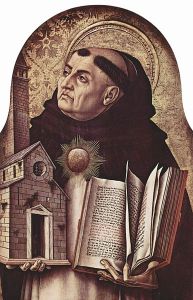
Aquinas, and his conclusions from natural law, are of crucial importance for gay and lesbian Catholics, so there’s a lot more to say about this.
I had been engaged in a series of posts on the “distorting tradition” in Christian history, which got somewhat derailed by extensive exchanges on facebook and email after my posts on what British Catholics believe, and thoughts arising from Bishop Conry’s project to lure back lapsed Catholics (which feeds right in to the pope’s ideas). Those exchanges , which ranged widely, but led me to think in terms of a series on conscience - but now, this important interview has derailed that line of enquiry, too.
I’ll attempt to bring it all together, by investigating the distorted tradition of Natural Law as “bankrupt Thomism”. But that will take serious work and time. I;ve long been wanting to go into this, but have felt severely intimidated. I just don’t have the training and expertise to comment directly on Thomas, myself. I am dependent on commentary I have found elsewehere.
I begin by reminding you of just what Pope Francis had to say about the need for the Church, including its doctrines, to continually evolve (for the context of these quotations, see “Pope Francis, on Why and How the Church Must Change”)
He opens to the Office of Readings for Friday of the 27th Week in Ordinary Time and reads me a passage from the Commonitorium Primum of St. Vincent of Lerins: “Even the dogma of the Christian religion must follow these laws, consolidating over the years, developing over time, deepening with age.”
- America, Papal interview
and
Here, human self-understanding changes with time and so also human consciousness deepens. Let us think of when slavery was accepted or the death penalty was allowed without any problem. So we grow in the understanding of the truth. Exegetes and theologians help the church to mature in her own judgment. Even the other sciences and their development help the church in its growth in understanding. There are ecclesiastical rules and precepts that were once effective, but now they have lost value or meaning. The view of the church’s teaching as a monolith to defend without nuance or different understandings is wrong.
This chimes well with the argument presented by the Catholic theologians Salzmann and Lawler, in their valuable book “The Sexual Person“, that sound theology must be grounded in an understanding of its “historicity”. The rationale for this approach is presented in the book’s opening chapter. I present here, without further comment, some extracts which I think are particularly relevant to the pope’s thinking, and to a sound understanding of Aquinas which avoids “bankrupt” Thomism, and which will be central to my own later postings.
In the first, they are drawing on the work of Joseph Fuchs:
…for this reason, Joseph Fuchs argues, correctly in our judgement, that anyone wishing to make a moral judgement about any human action in the present on the basis of its givenness in the past must keep at least two facts in mind.
The first fact is that those living in the past simply did not know either the entire reality of the human person, from its emergence to its full development in the future, nor its individual elements, from the mysterious powers of the physical universe to the long - hidden possibilities of human biology and human sexuality considered biologically, psychologically, and sociohistorically. “If one wishes to make an objective moral judgement today, ” Fuchs points out, “then one cannot take what Augustine or the philosophers of the Middle Ages knew about sexuality as the exclusive basis of a moral reflection.” The second fact is that “we never simply ‘have’ nature or that which is given in nature.” We know nature “nature” rather, “always as something that has already been interpreted in some way.” ….In the Catholic moral tradition, argument is never from “nature” alone or reason alone, but always a question of “nature” interpreted by reason.
In the second, they are drawing on Bernard Lonergan:
Bernard Lonergan was convinced that something new was happening in history in the twentieth century and that, because a living theology ought to be part of what was taking place in history, Christians were living in a new theological age that required a new theological approach. This new approach, he prophesied correctly, would be necessarily historical and empirical. His distinction between a classicist and empirical notion of culture has itself become classical: “The classical notion of culture was normative: at least de jure there was but one culture that was both universal and permanent.” The empirical notion of culture was “the set of meanings and values that informs a way of life. It may remain unchanged for ages. It may be in the process of slow development or rapid resolution”. Classicist culture is static; empirical culture is dynamic. Theology, which is necessarily part of culture, mirrors this distinction.
and
Classicist theology sees moral norms coming from the Magisterium as once and for all definitive; sexual norms enunciated in the fifth or sixth centuries continue to apply absolutely in the twenty - first century. Empirical theology sees the moral norms of the past not as facts for uncritical and passive acceptance but as partial insights that are bases for critical attention, understanding, evaluation, judgement and decisions in the present sociohistorical situation. What Augustine and his medieval successors knew about sexuality cannot be the exclusive basis for a moral judgement about sexuality today. The Second Vatican Council adopted a historical, empirical approach to theological (including moral theological) judgements as well as a focus on the person rather than on the person’s acts, but the Roman Magisterium continues to support its teaching on sexual morality by quoting the past tradition as if it did not suffer from historicity.
Related articles
- Pope Francis, on Why and How the Church Must Change
- The Natural Law Case for Same - Sex Marriage
- Conscience and the Queer Catholic
- British Catholics Are Tolerant of Same - Sex Sexual Relations
- Pope Francis’s Exclusive Interview with America: A Church That Is “the Home of All, Not a Small Chapel”-10 Initial Reflection Points (bilgrimage.blogspot.com)
- And Yet More Commentary on Pope Francis’s Interview: Resetting Catholic Conversation, People of God, and Nuns on Bus (bilgrimage.blogspot.com)
- The End of the Para-Creed? (commonwealmagazine.org)
- The “Developing Theology” of Women (mysteriesandmanners.wordpress.com)


Thanks for linking to my blog!
I appreciate your post and its thoughtfulness, and I thought that maybe you would be interested in this:
http://www.patheos.com/blogs/faithonthecouch/2013/09/papa-francis-the-prodigal-and-the-good-son/
I think we probably disagree on a lot of things - perhaps especially what we believe Pope Francis is saying about Church teaching on moral issues like sexuality. But we seem to agree on the most important thing, which is our love for Christ.
God bless!