A wonderful example of a sainted bearded lady? The Catholic Church once officially recognised July 20th as her feast day.
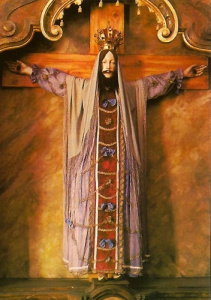
Unfortunately, she may also be an example of a ‘saint’ whose biography is more popular fiction than recorded history. Still, she is listed in the standard catholic reference works, and has had an official feast day, as well as a bewildering array of aliases, among them Liberata, Kummernis, Uncumber, and Livrade, Kittredge Cherry at Jesus in Love blog expands on these names, with some notes on their origins:
The name Wilgefortis may come from the Latin “virgo fortis” (strong virgin). In Spanish she is Librada — meaning “liberated” from hardship and/or husbands. She also goes by a bewildering variety of other names. Her alternate English name Uncumber means escaper. In addition, she is known as Liberata, Livrade, Kummernis, Komina, Comera, Cumerana, Ulfe, Ontcommen, Dignefortis, Europia, and Reginfledis.
Of the biographical details, take them as you will. For what it is worth, the legend says that she was the daughter of a king, who had taken a vow of virginity. When her father wanted to marry her off to the King of Sicily, she prayed for deliverance from this evil fate. Whereupon she grew a beard. What self-respecting king would want to marry a bearded princess? Her father was said to be so enraged at this that he had her crucified. This may be the reason she bacme known as the patron saint of difficult marriages - but crucifixion seems an extreme way to end one.
Modern sceptical scholars suggest that the story of her beard and crucixion are sheer invention, arising from a misinterpretation of a conventional crucifix, with Christ in a tunic, incorrectly identified as a woman in a dress. Spoilsports! Why let facts get in the way of a good story? Sadly, her cult was supressed and she was dropped from the calendar in 1969 (along with many others who had been treated for centuries as saints by popular acclaim, including Saints Sergius and Bacchus).
Myth or not, as a gender transgressive person of deep faith, Kittredge Cherry has a note on why her story is today of importance to LGBT Christians :
Contemporary readers have come up with many theories about Wilgefortis. She has been interpreted as the patron saint of intersex people, an asexual person, a person with Polycystic Ovary Syndrome or a powerful lesbian virgin.

Related articles
- Saint Wilgefortis: Bearded woman (jesusinlove.blogspot.com)
- Jemima Wilkinson: Queer preacher reborn in 1776 as “Publick Universal Friend” (jesusinlove.blogspot.com)
- Pauli Murray: Queer saint who stood for racial and gender equality (jesusinlove.blogspot.com)
- UpStairs Lounge fire remembered 40 years later: 32 died in deadliest attack on LGBT people (jesusinlove.blogspot.com)


I told my beloved Audrey that you called me “a gender transgressive person” and she exclaimed, “That’s high praise!” and gave me a kiss.
Thanks for the praise and for sharing my thoughts on Wilgefortis. I had forgotten that Sergius and Bacchus were also removed from the official saint list in 1969 — ironically, the same year as Stonewall ignited the LGBT rights movement. Happy Wilgefortis Day!
A Spanish translation of my article about Wilgefortis is online now at Santos Queer, my new Spanish-language blog:
Santa Librada (Wilgefortis): Santa mujer barbuda
http://santosqueer.blogspot.com/2013/07/santa-librada-wilgefortis-una-santa.html
A friend is helping me translate my profiles of LGBT saints into español.
Thanks, Kitt. I saw your reference earlier to Santosqueer, but the link to this specific post was not then working. I’m pleased to see that it is, now.